Why Is Thriller the Best-Selling Album Ever?
The best selling album of all time is generally recognized as Thriller by Michael Jackson, with worldwide sales often estimated at around 70 million copies. The main thing to check is whether a ranking is talking about global estimated sales, U.S. certifications, or modern streaming-equivalent units, because those can lead to different answers.
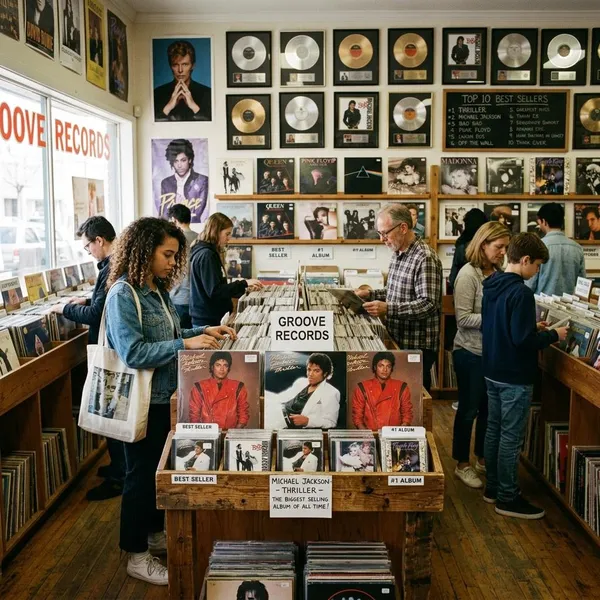
What is the best-selling album of all time?
Thriller is the clearest global answer. Most all-time album lists place it at number one because its worldwide lifetime sales are higher than other major contenders such as AC/DC's Back in Black, Pink Floyd's The Dark Side of the Moon, and the Eagles' Their Greatest Hits (1971–1975).
Thriller by Michael Jackson
Thriller was not just a huge Michael Jackson album; it became one of the rare records that reached casual listeners, serious pop fans, dance audiences, R&B fans, and rock listeners at the same time. That broad reach is why it still sits above albums that were massive in one country or one genre but slightly narrower worldwide.
Released in 1982
The album was released in 1982, which gave it a major advantage. Full-album purchases were still the normal way to own music, and listeners who liked several songs usually bought the record, cassette, or later the CD rather than cherry-picking tracks.
Its timing also lined up with the rise of MTV. That mattered because Thriller was promoted not only as music to hear, but as pop culture to watch.
Why has Thriller sold so many copies?
Thriller kept selling because it had more than one source of momentum. The songs worked on radio, the videos made the album unavoidable on television, and its reputation kept pulling in new listeners long after the original release cycle ended.
Worldwide pop appeal
The album crossed markets unusually well because it blended pop, R&B, dance, funk, and rock-friendly production without feeling scattered. That made it easier for different radio formats, countries, and age groups to connect with it.
- Pop listeners had polished hooks and big choruses.
- Dance audiences had rhythm-driven tracks that stayed useful at parties and clubs.
- Rock listeners had enough edge, especially through tracks like "Beat It," to take it seriously.
- Family buyers could recognize several songs, which made the album feel worth owning.
Multiple hit singles
Several hit singles gave Thriller a longer commercial life than a typical album. Each major single renewed attention, pushed the album back into stores and radio rotation, and gave undecided buyers another reason to purchase the full record.
Groundbreaking music videos
The music videos turned the album into a visual phenomenon. The "Thriller" video in particular felt closer to a short film than a standard promotional clip, with choreography, costumes, horror imagery, and a scale that made people talk about it even outside normal music circles.
For someone comparing it with modern releases, this is the pre-social-media version of going viral: repeated television exposure, schoolyard conversation, radio play, and record-store demand all feeding each other.
Decades of continued sales
Thriller did not stop selling after the 1980s. Fans bought it across vinyl, cassette, CD, digital download, deluxe editions, and later streaming-era formats. Some buyers also replaced older copies when music formats changed.
That matters for lifetime totals. A short-term blockbuster can dominate for a year, but a catalog album that stays visible for decades can keep adding sales in smaller waves.
Cross-generational popularity
One generation bought Thriller when it was new; later generations met it through radio, family collections, Halloween playlists, documentaries, dance clips, and pop-culture references. That handoff is a big reason the album still feels active rather than frozen in the 1980s.
If a younger listener only knows the title track, the full-album sales record may seem surprising. If they recognize "Billie Jean," "Beat It," "Thriller," and the surrounding cultural impact, the number makes much more sense.
Why do album sales figures vary?
Album sales figures vary because sources are often measuring different things. A worldwide estimate is not the same as an official certification in one country, and a pure album sale is not the same as a streaming-equivalent unit.
- Worldwide estimated sales usually point to Thriller as the leader.
- U.S. certified sales may point to the Eagles instead.
- Streaming-equivalent totals can favor newer albums with huge playlist activity.
Older sales records can be incomplete
Older albums were sold in a world with less consistent global tracking. Some countries had weaker reporting systems, some sales were logged as shipments, and some historical totals were never updated cleanly.
That does not make every old number useless. It does mean that a worldwide figure for a classic album is often a carefully supported estimate rather than one single official count accepted everywhere.
Certification systems differ by country
Certification rules are national, not global. The RIAA measures U.S. certifications, while other countries use their own thresholds, rules, and update habits.
Estimates use different sources
One publication may use only certified totals, while another may combine certifications, label claims, chart research, shipment history, and regional sales evidence. A conservative estimate may look lower simply because it refuses to count anything that is not strongly documented.
For practical reading, do not worry too much about small differences such as one source listing roughly 65 million and another listing around 70 million. The bigger point is whether the source is comparing the same type of number.
Albums continue earning new certifications
Classic albums can receive new certifications years after release, especially when labels or rights holders request an update. A public certification number may lag behind actual long-term demand until that update happens.
That is why an album can appear to "jump" in certified sales even if the extra demand built slowly over many years through catalog sales, reissues, digital purchases, or eligible streaming activity.
Streaming-equivalent units complicate comparisons
Streaming-equivalent units are useful for modern charts, but they make all-time comparisons messier. Buying a full album in 1983 is not the same behavior as streaming a few songs many times in 2024.
If you want the cleanest historical comparison, look for "pure sales" or "worldwide album sales." If you want to understand current popularity, streaming-equivalent units can be helpful, but they answer a broader question.

Conclusion
Thriller remains the strongest answer because it combines worldwide sales, cultural reach, and decades of continued demand in a way no other album has clearly matched. The only real confusion comes from mixing different scoreboards, so check whether the number refers to global estimates, U.S. certifications, or streaming-era units before comparing records.
FAQS
How many copies has Thriller sold worldwide?
Thriller is commonly estimated at around 70 million copies worldwide. Treat that as an estimate, not a perfectly fixed audited total.
What is the best-selling album in the United States?
In U.S. certification discussions, the Eagles' Their Greatest Hits (1971–1975) is often listed at the top. That ranking is specific to the American market.
What is the second best-selling album of all time?
AC/DC's Back in Black is commonly named as the second best-selling album worldwide. Exact totals vary because sources do not all use the same evidence.