Which Beatles Album Should You Listen to First?
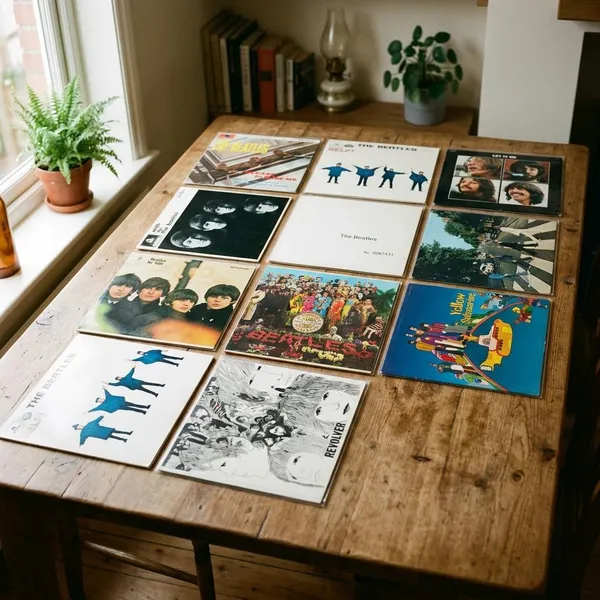
If you are trying to make sense of beatles albums, start with the UK studio run: 12 core albums from Please Please Me to Let It Be. Many modern lists count 13 because Magical Mystery Tour is now treated like a full album on streaming and in the standard catalog. The easiest way in is to use the album order for context, then choose a starting point that matches how you like to listen.
Beatles albums in order
The cleanest album order is the original UK studio discography, with one note: Magical Mystery Tour began as a UK double EP, but the expanded US LP later became the standard version. That is why a careful list often explains both the 12-album and 13-album count instead of pretending there is only one answer.
| Period | Main albums to hear | What to listen for |
|---|---|---|
| 1963–1964 | Please Please Me, With The Beatles, A Hard Day's Night, Beatles for Sale | Live-band energy, tight harmonies, fast-developing songwriting |
| 1965–1966 | Help!, Rubber Soul, Revolver | More personal writing, folk-rock color, bigger studio ideas |
| 1967 | Sgt. Pepper's Lonely Hearts Club Band, Magical Mystery Tour | Psychedelia, colorful production, album-as-experience thinking |
| 1968–1970 | The Beatles, Yellow Submarine, Abbey Road, Let It Be | Individual styles, late studio polish, a less tidy final chapter |
How did the Beatles sound change across their albums?
The simple arc is early rock and pop, then folk-leaning maturity, then psychedelic studio experimentation, then a late period that mixes polish with fragmentation. That shift is why the album order is useful: the band did not just improve, they kept changing the rules of what a Beatles record could sound like.
Early rock and pop
The early albums are built around rhythm, harmony, and momentum. The arrangements are usually straightforward, but they are not thin: the vocals, guitars, bass, and drums lock together with the confidence of a band that had already done serious live work before becoming famous.
These records are especially good for casual listening: a short commute, cooking dinner, or trying one album without turning it into a music-history assignment. The songs move quickly, and the appeal is immediate.
Folk rock and mature songwriting
The shift into Help! and Rubber Soul brings softer textures, more reflective lyrics, and a stronger sense of mood. The band keeps the melodies, but the songs no longer feel only built for excitement and charm.
If the early albums feel too lightweight to you at first, this is the section that may change your mind. Rubber Soul in particular is a useful middle ground because it sounds grown-up without becoming heavy or difficult.
Psychedelic experimentation
Revolver, Sgt. Pepper, and Magical Mystery Tour show the Beatles treating the studio as part of the music, not just a place to record it. Tape effects, unusual instruments, layered arrangements, and dreamlike textures become central to the sound.
- Try Revolver first if you want experimentation with tight song lengths.
- Try Sgt. Pepper first if you want a more immersive album world.
- Try Magical Mystery Tour after those if you want the singles and side roads from the same period.
Late-period studio sound
The late albums do not move in one single direction. The White Album spreads out, letting different personalities and styles sit next to each other. Abbey Road tightens things again with a cleaner, richer studio sound. Let It Be keeps some of the back-to-basics idea, even though the released album is not simply a raw live document.

Best Beatles albums to start with
The best first Beatles album depends on your patience for older production, your interest in experimentation, and whether you want a single polished listen or a chronological journey. If you only want one album tonight, choose Abbey Road. If you want to understand the band's development, start with Rubber Soul or Revolver. If you care about the original spark, begin at Please Please Me.
Abbey Road for an accessible first listen
Abbey Road is the safest recommendation because it sounds polished, melodic, and complete. It has individual songs that work right away, but it also has the side-two medley for people who want the feel of a full album journey.
Choose it if you are introducing the Beatles to someone who does not usually listen to 1960s records. It gives them strong songs first and historical context later, which is usually the better order.
Rubber Soul for the transition years
Rubber Soul is where the Beatles become warmer and more introspective without losing accessibility. It is a smart first choice if you want to hear change rather than start with the biggest production statement.
This album suits a listener who likes subtle growth: acoustic color, thoughtful lyrics, and a consistent mood. It is not as immediately grand as Abbey Road, but it may be the better doorway if your taste leans toward intimate songwriting.
Revolver for experimentation
Revolver is the best start for someone who wants to understand why the Beatles are called innovative. The ideas are bold, but the album stays concise, varied, and easy to replay.
- Good fit: you like creative production and unusual textures.
- Possible mismatch: you mainly want the cleanest, smoothest first listen.
- Best next step: follow it with Sgt. Pepper to hear the psychedelic side expand.
Sgt. Pepper for psychedelia
Sgt. Pepper's Lonely Hearts Club Band works best when you want an album with a strong identity and a sense of performance. It is not just a batch of songs; the atmosphere and sequencing are part of the point.
It may not be the simplest first Beatles record for everyone. If you enjoy concept albums, theatrical pop, or records that ask for focused listening, it is a strong entry. If you want something more direct, start with Abbey Road and come back to it.
Please Please Me for the early sound
Please Please Me is the right starting point if you care about the beginning more than the most polished version of the band. It is quick, energetic, and easy to understand: a young group with strong voices, sharp timing, and obvious charm.
The trade-off is that it does not show the full artistic range people usually associate with later Beatles albums. Pick it for a chronological journey, not because it is the most complete first impression.
Best Beatles albums by era
If a full discography listen feels like too much, sample one album from each era. This gives you the shape of the Beatles' development without asking you to sit through every release immediately. It is also a better method than starting with a random "best of" ranking, because each era wins for a different reason.
A Hard Day's Night for the early years
A Hard Day's Night is the early-era pick because it captures Beatlemania while showing real songwriting control. It is all Lennon-McCartney originals, which gives it a cleaner identity than the first two albums.
Rubber Soul for the mid-1960s transition
Rubber Soul represents the middle transition better than any other album because it still welcomes new listeners while clearly moving away from the early formula. The mood is calmer, the lyrics are more shaded, and the arrangements feel more considered.
Revolver for the experimental period
Revolver is the strongest experimental-era pick because it is adventurous without being bloated. It moves quickly from one idea to another, which makes the invention feel alive rather than decorative.
Use it as the test for whether the Beatles' studio era is your favorite part of the catalog. If this album grabs you, Sgt. Pepper and Magical Mystery Tour will probably make more sense afterward.
Abbey Road for the late era
Abbey Road is the late-era choice because it turns a difficult band moment into a record that still feels elegant and unified. The production is smooth, the performances are focused, and the medley gives the album a memorable final shape.
It is also the easiest late album to recommend without qualification. The White Album is richer in range, but Abbey Road is the better first stop for most listeners.

Conclusion
The best route through the Beatles catalog depends on what you want from the first listen: choose Abbey Road for the smoothest entry, Rubber Soul for the turning point, Revolver for invention, or Please Please Me if you want the full story from day one. Count 12 albums if you are following the core UK studio discography, and 13 if you include Magical Mystery Tour as the modern standard album version. Either way, the real reward is hearing how quickly the band moved from sharp pop songs to records that changed what pop albums could do.
FAQS
How many Beatles albums are there?
There are 12 core UK studio albums. The number becomes 13 when Magical Mystery Tour is counted as a full album, which is common in modern catalog and streaming contexts.
Why is Magical Mystery Tour sometimes counted as an album?
Because the expanded US LP version became the standard worldwide version later on. The original UK release was a double EP, so older or stricter UK-based lists may treat it differently.
What is the best Beatles album to start with?
Abbey Road is the easiest first choice for most listeners. Choose Rubber Soul instead if you want a gentler bridge from early pop into more mature songwriting.