What Is the Order of Bangtan Sonyeondan Albums?
If you want Bangtan Sonyeondan albums in order, start with the Korean group releases first, then add Japanese studio albums as a parallel discography. The main thing is not to treat every BTS release as the same type: some are studio albums, some are mini albums, some are repackages, and Proof is an anthology. For a new listener, the easiest route is usually Proof for an overview or one full era such as Love Yourself or Map of the Soul.

BTS Korean albums in order
The Korean catalog is the core line of BTS's group discography. It is where the main eras, concepts, and turning points are easiest to follow, even though some important releases are not full studio albums.
Debut and School Trilogy releases
BTS began in 2013 with 2 Cool 4 Skool, a single album rather than a full-length studio album. It introduced the early hip-hop-heavy sound, direct social commentary, and the debut track "No More Dream."
O!RUL8,2? and Skool Luv Affair continued the School Trilogy idea with themes of pressure, dreams, young love, and self-definition. If you are mainly interested in polished later BTS, this era may feel raw; if you want to hear the group's roots, it is essential.
Dark & Wild followed in 2014 as BTS's first Korean full-length studio album. It works as a bridge between the debut-school concept and the more emotionally layered albums that came next.
The Most Beautiful Moment in Life era
The Most Beautiful Moment in Life, Pt. 1 and Pt. 2 changed the scale of BTS's storytelling. The sound became more melodic and atmospheric, while the themes moved toward youth, uncertainty, friendship, fear, and hope.
The Most Beautiful Moment in Life: Young Forever brought that period together as a special compilation-style release. For listeners who like albums with a strong emotional mood rather than only big singles, the HYYH era is one of the best places to spend time.
Wings and You Never Walk Alone
Wings, released in 2016, was BTS's second Korean studio album and one of their most ambitious concept projects. It added solo tracks for each member and leaned into temptation, growth, fear, and identity.
You Never Walk Alone is the repackage, but it should not be treated as an optional footnote. It adds songs that soften and complete the emotional arc of Wings, which is why many fans listen to the two together.
Love Yourself era
The Love Yourself era moves in three steps: Her, Tear, and Answer. That makes it especially easy for new listeners to understand because the emotional path is clear: attraction, fracture, and self-acceptance.
- Love Yourself: Her: brighter, more accessible, and often a good first mini album.
- Love Yourself: Tear: darker and more cohesive as a full studio album.
- Love Yourself: Answer: a compilation-style closing release with key additions.
Map of the Soul era
Map of the Soul: Persona opened this era in 2019 with a bright surface and questions about public image underneath. Map of the Soul: 7 expanded that idea into a larger full-length album about shadow, ego, fear, success, and resilience.
This is a good era for listeners who already know a few BTS hits and want a bigger picture of the group. It includes group tracks, solo moments, polished pop, rap-heavy cuts, and more reflective songs, so it gives a wide view without going all the way back to debut first.
BE and Proof
BE arrived in 2020 with a more intimate tone. Instead of building a huge concept world, it reflects daily life, uncertainty, comfort, and connection during a difficult period.
Proof, released in 2022, is an anthology album, not a standard studio album. It is useful if you are a casual listener who wants a curated overview before choosing an era, but it is less satisfying if you want the original album-by-album progression.
ARIRANG
ARIRANG should be handled carefully in a BTS album list. It is not usually classified beside official group albums such as Wings, BE, or Proof in the core BTS discography.
BTS Japanese albums in order
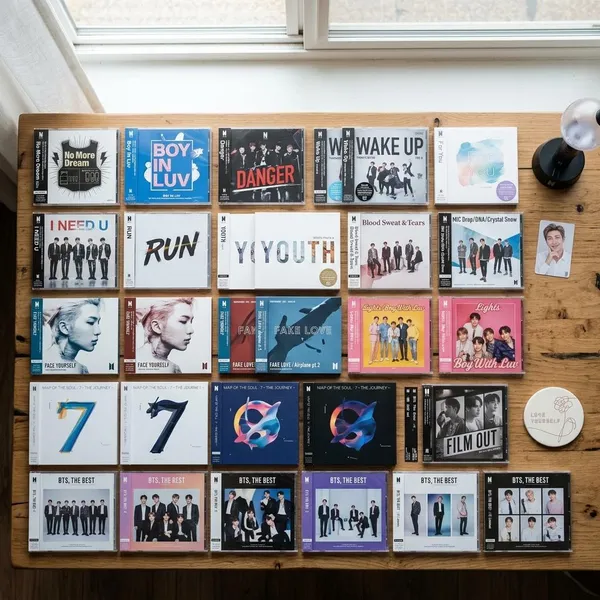
BTS Japanese albums are official releases, but they are best understood as a parallel album line. They often include Japanese versions of Korean songs, along with original Japanese tracks that are not simply translations.
Wake Up
Wake Up, released in 2014, was BTS's first Japanese studio album. It reflects the early, energetic version of the group and includes Japanese versions of earlier Korean material plus original Japanese songs.
Youth
Youth followed in 2016 and connects closely with the emotional tone of the HYYH period. It is a stronger pick than Wake Up if you prefer melodic, reflective BTS over the rougher school-era sound.
Face Yourself
Face Yourself, released in 2018, is often the easiest Japanese BTS album to recommend. It sits near the Love Yourself period and includes originals such as "Don't Leave Me" and "Let Go," which help it feel like its own project.
Map of the Soul: 7 – The Journey
Map of the Soul: 7 – The Journey, released in 2020, is the fourth Japanese studio album. It reflects a more polished, globally established BTS and fits naturally beside the wider Map of the Soul period.

How are BTS albums organized?
BTS albums are easiest to organize by release type first and era second. That prevents the common mistake of comparing a mini album, a repackage, a Japanese studio album, and an anthology as if they were the same kind of release.
| Release type | How to treat it | Good listener use |
|---|---|---|
| Korean studio album | Main full-length group statement | Best for hearing a complete era |
| EP or mini album | Shorter but often era-defining | Best for quick entry into a concept |
| Repackage or compilation | Adds and reshapes an era | Best after hearing the related release |
| Anthology | Curated career overview | Best for new or returning listeners |
| Japanese studio album | Parallel official discography | Best after knowing the Korean timeline |
BTS albums by era
Sorting BTS albums by era is often more useful than memorizing release types. Each era has a different mood, so your best starting point depends on what kind of BTS you want to hear: raw and youthful, emotional and cinematic, polished and global, or reflective and mature.
School Trilogy
The School Trilogy includes 2 Cool 4 Skool, O!RUL8,2?, and Skool Luv Affair. Pick this era if you want early BTS: direct, hungry, rap-forward, and focused on youth pressure, dreams, rebellion, and first love.
The Most Beautiful Moment in Life
The HYYH era includes The Most Beautiful Moment in Life, Pt. 1, Pt. 2, and Young Forever. It is a strong choice if you like bittersweet coming-of-age music with emotional storytelling.
Wings
Wings and You Never Walk Alone form a dramatic, conceptual era with solo tracks, darker imagery, and a bigger performance identity. It is a good pick if you want ambition and theatricality rather than the most immediately simple entry point.
Love Yourself
The Love Yourself era is one of the safest recommendations for new listeners because it balances accessibility and depth. Her is bright, Tear is emotionally sharper, and Answer gives the widest view of the trilogy.
Map of the Soul
Map of the Soul: Persona and Map of the Soul: 7 focus on identity, image, shadow, ego, and the pressure of being seen. This era works best for listeners who want a large, layered album experience with both polished pop and introspection.
BE and Proof
BE is more intimate and grounded, while Proof is retrospective. One is better for a specific emotional moment; the other is better for understanding the full career arc quickly.
ARIRANG
ARIRANG is not a confirmed BTS album era in the same way as School Trilogy, HYYH, Wings, Love Yourself, Map of the Soul, or BE/Proof. Treat it as a term that needs context, not as a standard stop in the album timeline.
Conclusion
The cleanest way to understand BTS's discography is to follow the Korean eras first, add repackages where they belong, then explore the Japanese albums as a parallel line. If you want the fastest overview, use Proof; if you want the most satisfying growth story, move era by era and do not skip the releases that complete each period.
FAQS
What was BTS's first full-length album?
BTS's first full-length Korean studio album was Dark & Wild, released in 2014. 2 Cool 4 Skool came earlier, but it was a single album, not a full-length album.
What is BTS's latest group album?
Proof, released in 2022, is the latest major BTS group album project. Member solo albums released afterward belong to individual discographies, not the group album line.
Is Proof a studio album or an anthology album?
Proof is an anthology album. It includes selected past songs and new material, so it is meant as a career overview rather than a fully new studio album.