Which Pink Floyd Album Should You Hear First?
If you want to explore Pink Floyd albums without getting lost, start with the release order but do not feel forced to listen that way first. The safest first album is usually The Dark Side of the Moon, while the full chronology shows how the band moved from Syd Barrett's psychedelic pop to massive concept records and later reflective work.
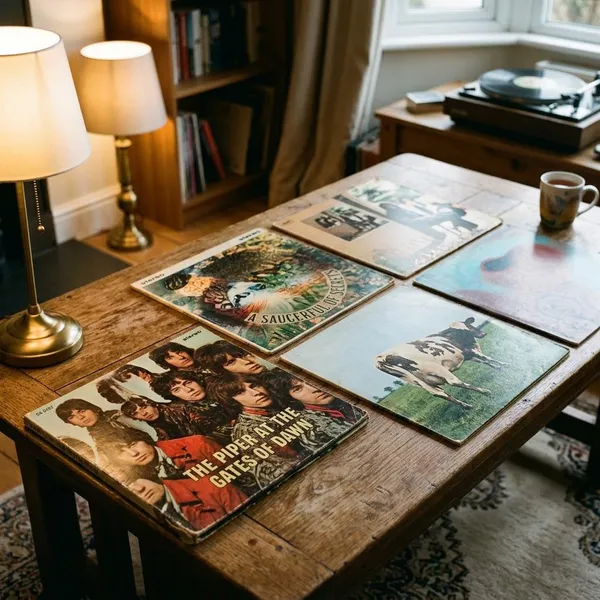
Pink Floyd's early albums in order
The early records are the least predictable part of the catalog. They matter because they show the band building its language, but they are not always the easiest place for a new listener to begin.
If you are listening chronologically, treat this era as a sketchbook: flashes of genius, strange detours, soundtrack work, and long-form experiments before the classic Pink Floyd sound fully settles.
The Piper at the Gates of Dawn
Released in 1967, The Piper at the Gates of Dawn is the Syd Barrett album more than any other Pink Floyd record. It is playful, odd, melodic, and spacey, with songs such as "Astronomy Domine," "Lucifer Sam," and "Bike" showing how naturally Barrett mixed pop hooks with surreal imagination.
A Saucerful of Secrets
A Saucerful of Secrets came out in 1968 and catches Pink Floyd mid-change: Barrett is fading from the group, David Gilmour has joined, and the band is searching for a new center. "Set the Controls for the Heart of the Sun" points toward the darker, hypnotic side they would develop later, while the title track leans harder into abstract atmosphere.
For a casual first listen, this is more historical than essential. For a chronological run, it is important because you can hear the band learning to survive without its original creative leader.
More
More, released in 1969, was written for the film of the same name, so it plays more like a set of moods than a single grand statement. "The Nile Song" is unexpectedly heavy, while "Cymbaline" and "Green Is the Colour" show the gentler acoustic side of the band.
- Best reason to hear it: you want to understand Pink Floyd's soundtrack work.
- Not ideal if: you want a polished concept album with a strong flow.
- Try first: "Cymbaline" if you prefer melodic Floyd, "The Nile Song" if you want the surprise.
Ummagumma
Released later in 1969, Ummagumma is one of the hardest Pink Floyd albums to recommend casually. The studio half gives each member room for individual experiments, which makes it fascinating in places and difficult in others.
Atom Heart Mother
Atom Heart Mother arrived in 1970 and feels like a bridge between the strange early years and the focused albums that followed. The long title suite is ambitious, with orchestration and choir parts, but the smaller songs on the second side are often easier to love.
"If" and "Fat Old Sun" are the practical entry points here. They hint at the warmth, space, and emotional patience that would soon become central to Pink Floyd's best work.

Pink Floyd's breakthrough albums in order
This is the run most people mean when they talk about classic Pink Floyd. The band kept the experimental instinct but shaped it into stronger songs, cleaner album concepts, and production that still feels immersive.
Meddle
Meddle, released in 1971, is the first album where Pink Floyd sounds fully confident. "One of These Days" has force, "Fearless" has warmth, and "Echoes" turns a side-long track into something patient, dramatic, and genuinely rewarding.
Choose this after one of the major classics if you want to hear the band's sound coming into focus. It is also a good pick for listeners who enjoy long tracks but do not want the rougher experimentation of the late-1960s records.
Obscured by Clouds
Released in 1972, Obscured by Clouds is another soundtrack album, this time for La Vallée, but it feels more relaxed and song-based than More. "Free Four," "Wot's... Uh the Deal," and "Childhood's End" make it one of the easiest overlooked albums in the catalog.
The Dark Side of the Moon
The Dark Side of the Moon, released in 1973, is the best first Pink Floyd album for most listeners. It has the songs, the themes, the sound design, and the album flow in one place, without requiring you to already understand the band's history.
Its practical advantage is balance. "Time," "Money," "Us and Them," and "Brain Damage" are memorable on their own, but the transitions and recurring sounds make the record feel like one continuous experience.
Wish You Were Here
Wish You Were Here came out in 1975 and is slower, sadder, and more spacious than The Dark Side of the Moon. Its emotional pull comes from absence: Syd Barrett's shadow, music-industry bitterness, and the feeling of people drifting away from each other.
"Shine On You Crazy Diamond" asks for patience, but it pays off if you like albums that build mood rather than chase quick hooks. For many longtime fans, this is the album that moves from impressive to personal.
Animals
Released in 1977, Animals is the sharpest album in the classic run. It is loosely tied to the social satire of George Orwell's Animal Farm, but the real draw is the bitter mood, long tense tracks, and leaner sound.
Pink Floyd's later albums in order
The later albums are easier to enjoy when you stop expecting every one of them to recreate the 1970s peak. This period includes a huge rock opera, a Roger Waters-dominated farewell to his time in the band, and the Gilmour-led records that followed.
The Wall
The Wall, released in 1979, is a rock opera about isolation, trauma, fame, and emotional collapse. It is long, theatrical, and sometimes deliberately uncomfortable, but its story gives new listeners a clear thread to follow.
"Another Brick in the Wall, Part 2" is the famous entry point, yet "Comfortably Numb," "Hey You," and "Run Like Hell" show why the album lasts beyond its biggest single. If you like records that feel cinematic, this may work better for you than the smoother classic albums.
The Final Cut
The Final Cut arrived in 1983 and is the most Roger Waters-centered Pink Floyd album. It is bleak, political, and lyric-heavy, with war and grief at the front rather than band interplay.
Do not start here unless you already know you like severe concept records. Heard after The Wall, it makes more sense as an intense aftershock; heard first, it can give a narrow impression of what Pink Floyd can do.
A Momentary Lapse of Reason
Released in 1987, A Momentary Lapse of Reason was the first Pink Floyd studio album after Roger Waters left. David Gilmour leads the sound, so the album is more guitar-led, atmospheric, and polished than confrontational.
"Learning to Fly" and "On the Turning Away" are the easiest songs to connect with. The production is very much of its time, so listeners who love 1980s textures may warm to it faster than those looking for the organic tension of the 1970s albums.
The Division Bell
The Division Bell, released in 1994, is the stronger later-period choice for many listeners who prefer atmosphere over argument. It is spacious, melodic, and more settled, with communication and distance running through the songs.
Try this when you want late-night Pink Floyd rather than dramatic Pink Floyd. "High Hopes," "Keep Talking," and "Coming Back to Life" are the key stops, especially if Gilmour's guitar tone is one of the main reasons you are listening.
The Endless River
The Endless River came out in 2014 and serves as the final Pink Floyd studio album. Built largely from material connected to The Division Bell period, it is mostly instrumental and works more as a reflective goodbye than a major new statement.
It is best saved for the end of the journey. As a first album, it is too quiet and context-dependent; as a closing listen, it has a gentle purpose.

Which Pink Floyd album should you hear first?
The best starting point depends on what you already enjoy, not on which album is considered the most important. If you want one safe recommendation, choose The Dark Side of the Moon; if you have a specific taste, the better first album may be different.
The Dark Side of the Moon for a balanced introduction
For most people, The Dark Side of the Moon is the right first choice because it explains Pink Floyd's appeal quickly without feeling shallow. It is accessible enough for a new listener and detailed enough to reward repeat plays.
The Piper at the Gates of Dawn for psychedelia
Choose The Piper at the Gates of Dawn first if your favorite 1960s music is colorful, eccentric, and slightly unhinged. It is the best entry point for listeners who care more about Syd Barrett, British psychedelia, and odd little songs than polished arena-scale albums.
The Wall for a story-driven album
The Wall is the best first pick for someone who wants a plot, recurring characters, and dramatic peaks. It is longer than The Dark Side of the Moon, but the narrative makes it easier to follow if you enjoy albums that unfold like a film.

Conclusion
The smartest way into Pink Floyd is to pick one album that matches your taste, then use the release order to understand how the band changed. Start with The Dark Side of the Moon if you want the safest doorway, The Piper at the Gates of Dawn if you want the psychedelic roots, or The Wall if you want a full story; after that, the rest of the catalog becomes much easier to place.
FAQS
Which Pink Floyd albums feature Syd Barrett?
Syd Barrett is central to The Piper at the Gates of Dawn and appears only briefly on A Saucerful of Secrets. For his strongest creative presence, the debut is the essential album.
Which albums were made after Roger Waters left?
The post-Roger Waters studio albums are A Momentary Lapse of Reason, The Division Bell, and The Endless River. They are mainly associated with David Gilmour's leadership and a more atmospheric direction.
What is Pink Floyd's best-selling album?
The Dark Side of the Moon is Pink Floyd's best-selling album and one of the best-selling albums of all time. Its lasting reach comes from how well it combines accessible songs with a complete album experience.