What Is the Order of Tyler, the Creator's Albums?
If you want a clear way into Tyler, the Creator albums, start with the main run from Bastard onward and treat each release as a different phase rather than just another title. Count Bastard if you want the full story, then choose your first listen by what you actually like: melody, concept, rap, or dance energy.
How many albums has Tyler, the Creator released?
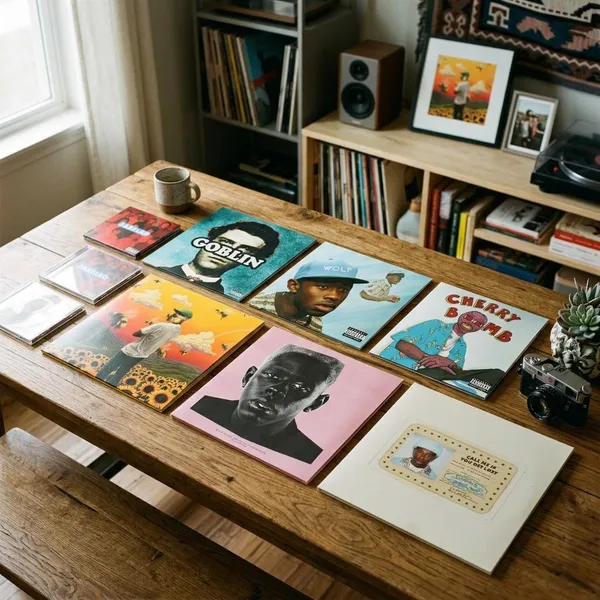
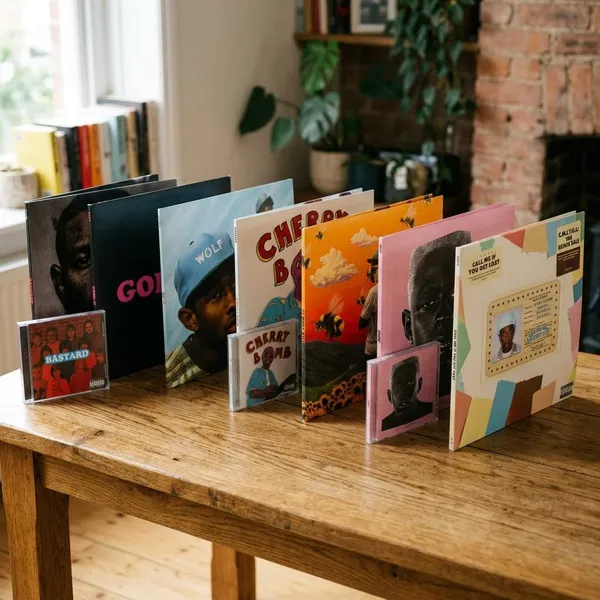
Tyler, the Creator has released nine major solo projects if you include Bastard: Bastard, Goblin, Wolf, Cherry Bomb, Flower Boy, IGOR, CALL ME IF YOU GET LOST, CHROMAKOPIA, and DON'T TAP THE GLASS.
The small catch is Bastard. It is often described as a mixtape, but Tyler has treated it as part of his core discography, and fans usually include it when talking about his album journey. If you are building a playlist or trying to understand his evolution, it makes sense to start there.
Do not count CALL ME IF YOU GET LOST: The Estate Sale as a separate main album. It adds important songs, but it functions as an expanded edition of the 2021 album rather than a new chapter in the same way IGOR or CHROMAKOPIA does.
Tyler, the Creator albums in order
Release order is the best route if you care about growth. You hear the shock-heavy early work, the messy experiments, the melodic breakthrough, the concept-album peak, and the later confidence in rap and rhythm. If you only want an easy first listen, skip ahead to the recommendation section, then come back to the timeline later.
Bastard
Bastard introduced Tyler in 2009 as a producer, rapper, character-builder, and world-maker all at once. The sound is rough and intentionally uncomfortable, with therapy-session framing, dark humor, and a DIY feel that explains why the early fanbase connected so strongly.
It is not the friendliest first listen now. Some writing is abrasive in a way that can be hard to revisit, but the album matters because the blueprint is already there: self-production, fictional framing, emotional messiness, and the habit of thinking in full albums instead of loose tracks.
Goblin
Goblin made Tyler impossible to ignore in 2011. "Yonkers" pushed him into a much bigger conversation, and the album doubled down on the unstable, confrontational style of his early era. It is historically important, but it is also one of the records where new listeners should be ready for material that has aged unevenly.
Wolf
Wolf is the early-period album I would point to before Goblin if someone wanted context without getting stuck in the harshest version of Tyler. The characters and aggression are still there, but the production is warmer and the songwriting feels more controlled.
Songs such as "IFHY" show the bridge clearly: he had not fully reached the openness of Flower Boy, but the chords, hooks, and emotional detail were becoming harder to miss.
Cherry Bomb
Cherry Bomb sounds like an artist throwing paint at the wall on purpose. It can be loud, distorted, soulful, beautiful, and chaotic within a short stretch, which is why it divides listeners. Its value is not neatness; its value is that many later Tyler ideas first appear here in a less polished form.
Flower Boy
Flower Boy is where Tyler's wider audience really opened up. The album is melodic, lonely, colorful, and much easier to live with than the early records. It keeps his personality but drops a lot of the defensive shock value.
IGOR
IGOR is less a rap album in the traditional sense and more a tightly sequenced breakup world. The synths, pitched vocals, rough edges, and emotional turns all serve the same story: wanting someone, losing control, and trying to regain dignity.
CALL ME IF YOU GET LOST
CALL ME IF YOU GET LOST brings Tyler's rap side back to the front without giving up the musical detail he built in the previous decade. DJ Drama's presence gives it mixtape energy, while Tyler's writing is sharper, funnier, and more technically confident than on most of his earlier work.
- Best for: listeners who want bars, confidence, and luxury-rap energy.
- Do not skip: the original album flow before treating The Estate Sale as bonus material.
CHROMAKOPIA
CHROMAKOPIA feels like Tyler looking at adulthood with fewer masks. The production still pulls from rap, soul, and jazz color, but the focus is more reflective: family, pressure, aging, responsibility, and the cost of always trying to be free.
DON'T TAP THE GLASS
DON'T TAP THE GLASS pushes the catalog toward movement. Where IGOR asks for attention and CHROMAKOPIA asks for reflection, this one is easier to put on when you want rhythm first.
That does not make it throwaway. The point is different: quicker energy, dance grooves, and a more physical kind of fun. For a car ride, a workout, or a room where people are actually moving around, it may connect faster than the denser records.
How has Tyler's sound changed?
Tyler's sound did not change because he abandoned his old instincts. It changed because he gained more control over them. The same interest in characters, strange chords, humor, and self-production runs through the catalog, but the balance shifts from provocation to arrangement, then to emotion, then to confidence and movement.
Raw beats and provocative storytelling
The early work is built on tension. The drums are blunt, the melodies are sparse, and the writing often tries to unsettle before it tries to comfort. That can make Bastard and Goblin difficult entry points, but it also explains why they stood out in the internet-rap moment of the late 2000s and early 2010s.
Jazz chords and melodic arrangements
By Wolf and especially Cherry Bomb, the music starts opening up. The chords become richer, the arrangements get brighter, and Tyler begins showing that he can build beauty without sanding off every weird edge.
Soul, synths, and personal themes
Flower Boy and IGOR are where the emotional writing becomes much more direct. Soul textures, synths, layered vocals, and softer melodies give Tyler room to write about loneliness, desire, jealousy, identity, and insecurity without hiding everything behind shock or jokes.
For many casual listeners, this is the point where the catalog finally clicks. If the early albums feel too harsh, starting here is not a mistake; it simply means you are entering through his most inviting period first.
Dance grooves and stripped-back rap
The later albums show Tyler choosing different tools for different moods. CALL ME IF YOU GET LOST proves how strong he can be as a rapper when he wants to compete bar for bar, while DON'T TAP THE GLASS leans into rhythm and physical energy.
Which Tyler album should you hear first?
The best first Tyler album depends on your listening habits, not on what fans say is the "correct" answer. If you want the lowest-risk entry point, choose Flower Boy. If you already know you prefer concept albums, rap performances, or dance tracks, start with the album that matches that mood and work outward.
Flower Boy for melody
Flower Boy is the easiest recommendation for someone who wants songs that feel warm, thoughtful, and replayable. It has enough melody for casual listening and enough personality to show why Tyler is not just a producer with nice chords.
IGOR for a breakup story
Pick IGOR when you want an album that behaves like a story. It is best heard in order because the emotional turns matter: obsession, jealousy, denial, collapse, and a strange kind of acceptance.
If you usually listen while multitasking, save it for a moment when you can pay attention. A few tracks can still stand alone, but the album's real strength is the way the songs bleed into each other.
CALL ME IF YOU GET LOST for rap
CALL ME IF YOU GET LOST is the best first choice for hip-hop listeners who want sharp verses, flexes, humor, and momentum. It is polished without feeling stiff, and it shows that Tyler's musical growth did not weaken his ability to rap with force.
DON'T TAP THE GLASS for dance tracks
Choose DON'T TAP THE GLASS if you want the most immediate modern entry point. It suits a more social setting: driving, moving around, or putting something on without asking everyone in the room to follow a heavy concept.
Conclusion
The smartest way to approach Tyler's catalog is to separate history from entry point: use release order when you want the full evolution, but start with the album that fits your taste if you want an immediate connection. Flower Boy, IGOR, CALL ME IF YOU GET LOST, and DON'T TAP THE GLASS each open a different door, and the early records make more sense once you know which version of Tyler pulled you in.
FAQS
Is Bastard an album or a mixtape?
Bastard is commonly called a mixtape, but it is usually included in Tyler's main album run because he treats it as the starting point of that story. For casual counting, just be clear whether your number includes it.
Which Tyler albums have won Grammys?
IGOR and CALL ME IF YOU GET LOST both won the Grammy for Best Rap Album. The interesting part is that they win for very different strengths: one is more conceptual and genre-blurring, while the other is more rap-forward.
Does Tyler produce his own albums?
Yes, Tyler is heavily involved in producing his own albums, which is a major reason each era feels so visually and musically specific. Even when he brings in features or collaborators, the overall direction usually feels tightly controlled by him.