What Do Movie Ratings Really Mean?
Movie ratings are a quick warning label, not a full parenting decision. The safest way to use them is to check the rating first, then read the content descriptor so you know whether the concern is language, violence, sex, drug use, or something emotionally intense.

What Are Movie Ratings
Movie ratings are content labels that help viewers judge whether a film is likely to fit a certain age group or comfort level. They do not tell you whether a movie is good, boring, educational, or worth watching; they only point to the type and strength of material inside it.
MPA ratings describe a movie's content level
In the United States, the Motion Picture Association rating system focuses on content such as language, violence, sexual material, nudity, drug use, and mature themes. A quiet drama can receive a strong rating because of language, while a loud action movie may receive the same rating for violence. The letter alone is useful, but the reason behind it matters just as much.
A board of parents assigns each rating
The rating is assigned by a board made up of parents who watch the submitted film and judge how most families may react to its content. This is not a government ruling or a film review. It is closer to a shared parental judgment about whether the material feels suitable for children, teens, or adults.
Ratings help families judge age suitability
Ratings work best as a first filter. If you are choosing a movie for a seven-year-old, a G or mild PG title is usually the safer place to start. If you are choosing for a group of teens, PG-13 may be fine, but the descriptor still tells you whether the issue is action violence, sexual references, drug content, or strong language.
- Check the rating first to remove obvious mismatches.
- Read the descriptor next to see what actually caused the rating.
- Think about the viewer, not only the age number. Some children handle fantasy battles easily but are upset by grief, suspense, or realistic harm.
Movie Ratings in Order
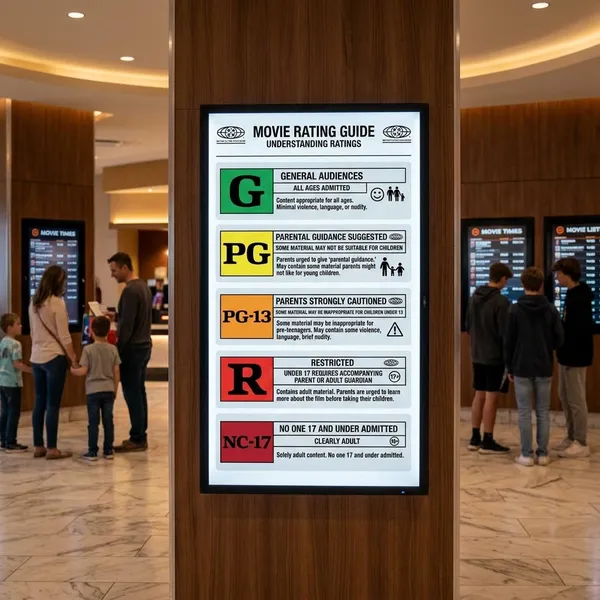
The five main MPA movie ratings in order are G, PG, PG-13, R, and NC-17. The order moves from broadly suitable for all ages to adults-only admission. For quick decisions, remember that PG and PG-13 are mainly caution labels, while R and NC-17 create stronger theater admission limits.
G means all ages admitted
G means General Audiences. All ages are admitted, and the content is generally considered suitable for children. You should not expect strong language, graphic violence, explicit sexual content, or detailed drug material.
PG means parental guidance suggested
PG means Parental Guidance Suggested. Some material may not be right for younger children, even though the movie is still aimed at a broad audience. Mild language, brief peril, emotional scenes, or slightly scary images are common reasons.
PG-13 means parents are strongly cautioned
PG-13 means Parents Strongly Cautioned. Some material may be inappropriate for children under 13, but the reason can vary a lot from one film to another.
This is the rating where the descriptor becomes especially important. A PG-13 superhero movie rated for action violence may be acceptable in one home, while a PG-13 comedy rated for sexual references and language may not be. The same label can lead to different decisions depending on your household rules.
R means viewers under 17 need an accompanying adult
R means Restricted. Viewers under 17 need an accompanying parent or adult guardian in theaters. R-rated films commonly include stronger language, more graphic violence, sexual content, nudity, drug use, or mature themes.
Do not assume every R-rated movie is intense in the same way. One may receive R mainly for repeated profanity, while another may involve graphic violence or explicit sexual material. For family viewing, this is usually the point where you should check the descriptor before saying yes.
NC-17 means no one 17 or younger is admitted
NC-17 means No One 17 and Under Admitted. Unlike R, a parent or guardian cannot simply accompany a younger viewer into the theater. The rating signals that the content is intended only for adults.
NC-17 does not automatically mean the film is illegal or obscene. It means the MPA has judged the content too mature for viewers 17 and younger, often because of explicit sexual material, extreme violence, or other adult subject matter.
How Movie Ratings Are Decided
A movie rating is based on the full viewing experience, not just a checklist of isolated moments. The board considers what appears on screen, how often it appears, how realistic it feels, and how strongly it may affect younger viewers.
The rating board watches the full movie
The board watches the completed film from start to finish. That matters because context can change the impact of the same content. One brief violent moment in a cartoon adventure may feel less intense than a slower, realistic scene showing fear, injury, and consequences.
Each board member submits a rating
After the screening, each board member submits an individual rating judgment. They are not only asking whether a type of content appears; they are also weighing severity, frequency, realism, tone, and whether the material feels central to the movie.
- Brief or implied content may have less impact.
- Repeated content can raise the overall intensity.
- Realistic presentation often feels stronger than stylized or comic presentation.
A majority vote sets the final rating
The final rating is set by majority vote. If filmmakers disagree with the result, they may edit the movie and submit it again, especially when the difference between PG-13 and R affects how widely the film can be marketed or shown.
This is why some movies are released in different cuts. A theatrical version may have one rating, while an unrated or extended home-release version may include material that was not part of the rated version.
A content descriptor explains the decision
The content descriptor is often the most useful part for everyday decisions. It gives a short reason for the rating, such as "strong language," "intense sequences of violence," "sexual material," or "drug references."
If you are picking a movie for a mixed-age family night, do not stop at the letter. A PG-13 rating for fantasy action may feel very different from a PG-13 rating for crude sexual content. The descriptor tells you which concern to weigh first.
What Can Raise a Movie Rating
A rating usually rises when content becomes stronger, more frequent, more realistic, or more explicit. The common mistake is looking only for one "bad" scene. In practice, a movie can move into a higher category because the mature material keeps building across the whole runtime.
Stronger or more frequent language
Language can raise a rating when profanity is stronger, repeated often, or used in a harsher context. A single mild word may not matter much, but constant profanity can change the feel of an otherwise simple comedy or drama.
More realistic or graphic violence
Violence is judged by more than the number of fights. Blood, visible injury, suffering, torture, panic, and realistic consequences can all make violence feel stronger.
More explicit sexual content or nudity
Sexual content and nudity can raise a rating quickly when scenes are detailed, prolonged, or central to the story. Light romance or brief innuendo may sit in a lower category, while explicit visual content usually pushes the rating higher.
More detailed drug use or smoking
Drug use becomes a bigger rating issue when the film shows use clearly, repeats it, explains it in detail, or makes it part of a character's lifestyle. Smoking may also appear in descriptors, especially when it is noticeable or tied to broader substance use.
For teens, the practical question is not only "does it appear?" but "how is it presented?" A passing reference is different from scenes that make drug use look glamorous, normal, or central to fitting in.
More intense themes or frightening scenes
Heavy themes can affect the rating even without graphic content. Death, grief, abuse, self-harm, trauma, and severe emotional distress may be too much for some younger viewers, especially when the movie treats them realistically.
- For sensitive children: scary images and suspense may matter more than the official age category.
- For group viewing: choose the movie based on the youngest or most sensitive viewer, not the most confident one.
- For uncertain cases: read the descriptor before the trailer, because trailers sometimes hide the exact issue that caused the rating.
Conclusion
The rating letter gives you the first signal, but the content descriptor is what turns movie ratings into a useful decision tool. For children, teens, or a mixed-age group, check the category, check why it was assigned, and then decide based on the actual viewer's sensitivities rather than the label alone.
FAQS
What does NR or unrated mean?
NR or unrated means the movie does not have an official MPA rating. It may be independent, older, a special cut, or simply not submitted, so treat it as "check further" rather than "safe" or "unsafe."
Is TV-MA higher than R?
Not exactly. TV-MA belongs to the television rating system, while R belongs to the MPA movie system; both suggest mature content, but they are not direct one-to-one ratings.
Are MPA movie ratings legally required?
No. MPA ratings are voluntary industry ratings, not U.S. government requirements, though theaters, distributors, and streaming services commonly use them.