Which Bob Dylan Albums Should You Hear First?
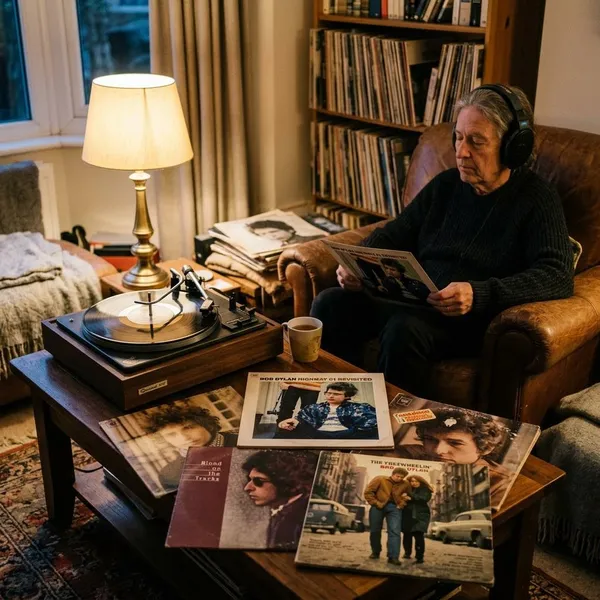
Start with the Bob Dylan albums that match how you already listen: The Freewheelin' Bob Dylan for acoustic folk, Highway 61 Revisited for electric rock, and Blood on the Tracks for personal songwriting. Trying to move through the catalog in strict order usually makes Dylan feel harder than he needs to be. A selective first pass gives you the landmarks without turning the discography into homework.
Which Bob Dylan albums should you hear first?
The best first choices are the records that explain why Dylan matters in different ways. One shows the folk songwriter, one captures the electric shock of the mid-1960s, and one makes his emotional storytelling easy to grasp without needing much historical context.
The Freewheelin' Bob Dylan
Start here if you want to understand Dylan's early reputation quickly. Released in 1963, The Freewheelin' Bob Dylan has "Blowin' in the Wind," "A Hard Rain's A-Gonna Fall," and "Don't Think Twice, It's All Right," but the bigger reason it works is the directness: voice, guitar, harmonica, and songs strong enough to carry the whole record.
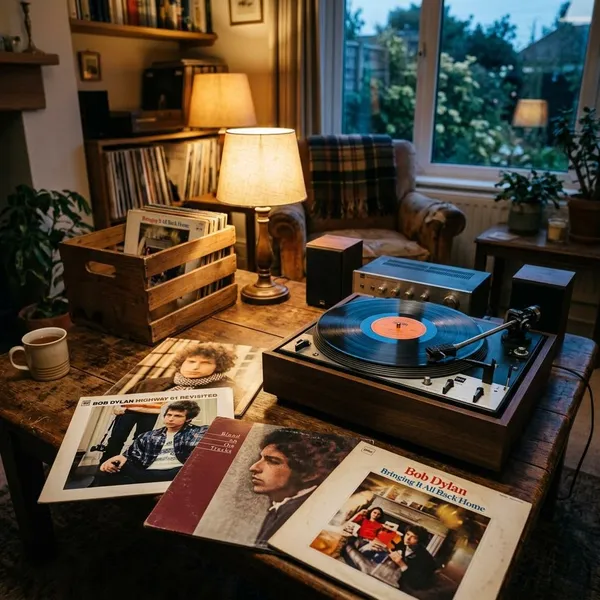
Bringing It All Back Home
This is the bridge record. One side pushes toward electric rock, while the other still keeps a foot in acoustic songwriting, so you can hear Dylan changing shape in real time rather than jumping straight from folk singer to rock provocateur.
"Subterranean Homesick Blues" has the snap and speed of the new Dylan, while "Mr. Tambourine Man" gives you the dreamier, more image-driven side. It is a smart second or third album if you want to understand the transition instead of only hearing the famous endpoints.
Highway 61 Revisited
Choose Highway 61 Revisited when you want Dylan at his most electric, sharp, and confrontational. "Like a Rolling Stone" is the obvious landmark, but the full album matters because the same restless energy runs through the whole record.
Blonde on Blonde
Blonde on Blonde is better as an early deepening step than as the very first stop for everyone. It is a double album, looser and more sprawling than Highway 61 Revisited, with songs that can feel playful, romantic, surreal, and elusive within the same stretch.
If you already enjoy Dylan's mid-1960s language, give this one a full-album listen rather than sampling highlights. "Visions of Johanna," "I Want You," and "Just Like a Woman" land better when the record's hazy atmosphere has time to build.
Blood on the Tracks
For many new listeners, Blood on the Tracks is the most emotionally immediate Dylan album. Released in 1975, it does not require you to care about the folk revival or the 1960s rock shift; it works because the songs feel lived-in, wounded, and sharply observed.
Where should you start based on your taste?
Your first Dylan album should come from your own listening habits, not from a ranking list. A casual listener who wants familiar songs may be better served by a compilation first, while someone who enjoys full albums should pick one clear era and stay with it for a few listens.
| If you usually like | Start with | Why this is the easiest doorway |
|---|---|---|
| Acoustic folk or singer-songwriters | The Freewheelin' Bob Dylan | The songs are exposed, direct, and easy to focus on. |
| Classic rock with attitude | Highway 61 Revisited | The band sound gives the writing force and speed. |
| Country or relaxed roots music | Nashville Skyline | It is short, warm, and less vocally abrasive. |
| Lyrics about love, memory, and regret | Blood on the Tracks | The emotional center is clear even without Dylan background. |
Which later Bob Dylan albums are worth exploring?
Later Dylan is worth hearing, but it helps to enter through the strongest records rather than filling every gap. The voice is rougher, the pacing is often slower, and the music leans into blues, old American song forms, and late-night atmosphere.
Do not expect these albums to recreate the shock of the 1960s. Their appeal is different: mood, phrasing, humor, age, and a sense that Dylan is still testing what old forms can do.
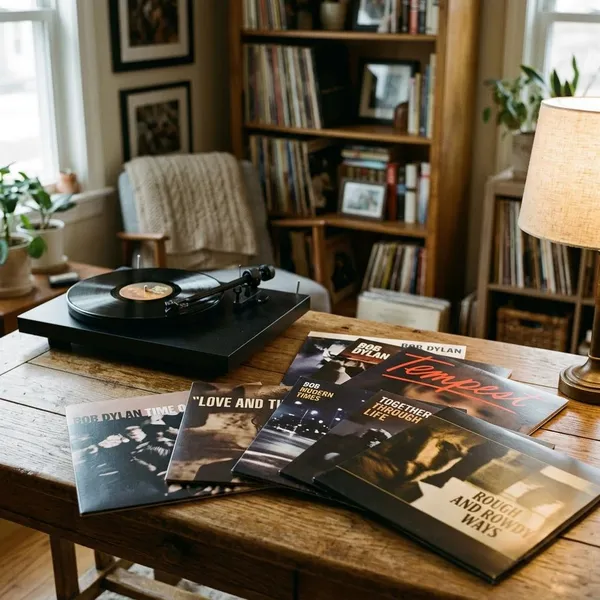
Time Out of Mind
Time Out of Mind is the best late-period starting point if you like dark, spacious records. Released in 1997 and produced by Daniel Lanois, it treats age, desire, fatigue, and endurance as atmosphere rather than as tidy themes.
It is not a quick album, so it suits a quiet evening better than a quick playlist scan. "Not Dark Yet" is the obvious center of gravity, but the record works best when its slow weather has time to gather.
Love and Theft
"Love and Theft" is livelier and more playful. Blues, swing, ragtime flavor, and rockabilly all move through it, but the record does not feel like a museum tour because Dylan sounds alert and amused.
- Try it after Time Out of Mind if you want more movement.
- Try it before Time Out of Mind if slow records test your patience.
- Skip it for later if you only want the famous 1960s sound right now.
Modern Times
Modern Times is a sturdy, road-tested late Dylan album. The band feels confident, the grooves are grounded in blues and roots music, and the pacing is more settled than flashy.
It is a good pick for listeners who care as much about feel as lyrics. If you like albums that sound worn-in rather than polished clean, this one has a lot of replay value.
Rough and Rowdy Ways
Rough and Rowdy Ways is the late-career album to hear when you are ready for something patient, literary, and strange. It is not built around obvious hooks, but it has a strong pull if you enjoy voice, atmosphere, and long lines of cultural memory.
For someone wondering whether late Dylan is merely respectable, this record gives the clearest answer. It sounds like an artist still making active choices, not just protecting a legacy.
Shadow Kingdom
Shadow Kingdom is best treated as a side path, not as the next major studio statement of new songs. It presents older Dylan material in newly shaped performances, so its value depends on hearing how the arrangements change the mood.
It is more rewarding after you already know a few originals. If you are brand new to Dylan, start with the classic albums first; if you are already familiar with them, Shadow Kingdom can make familiar songs feel smaller, stranger, and more intimate.
What else belongs in Dylan's discography?
Dylan's studio albums are only part of the story. Live recordings, greatest-hits collections, and archival releases matter because his songs often change meaning when the arrangement, phrasing, or performance setting changes.
Live albums and concert recordings
Live Dylan matters because the songs are rarely treated as fixed objects. He changes phrasing, tempo, emphasis, and sometimes the whole emotional temperature of a song.
If you want a practical starting point, try Before the Flood for big-stage energy or The Bootleg Series Vol. 5: Bob Dylan Live 1975, The Rolling Thunder Revue for a more theatrical, volatile performance style. These are better after you know at least a few studio versions, because the changes become part of the fun.
Greatest-hits collections
A greatest-hits collection is a perfectly reasonable first contact if you are a casual listener or just want to recognize the major songs. It gives you context quickly without asking you to commit to a full era.
The trade-off is that Dylan albums often depend on sequence and mood. Use a compilation as a map, not as the whole trip: when one or two songs stand out, follow them back to the album they came from.
The Bootleg Series and session recordings
The Bootleg Series is where Dylan's catalog becomes deeper rather than just larger. Outtakes, alternate versions, and live material show how songs developed and how many strong performances never landed on the original albums.
A sensible first archival stop is The Bootleg Series Vols. 1–3 because it covers a wide span instead of locking you into one period. After that, choose by taste: 1960s sessions if you love the electric trilogy, Rolling Thunder material if the 1970s pull you in, or later volumes once a specific era becomes your favorite.
Conclusion
The easiest way into Dylan is not to respect the catalog from a distance, but to pick one doorway that fits your taste and stay with it long enough for the songs to settle. For most people, that means The Freewheelin' Bob Dylan, Highway 61 Revisited, or Blood on the Tracks first, then a move outward into country, later records, live performances, or the archives once a particular side of him starts to make sense.
FAQS
What was Bob Dylan's first album?
His first album was Bob Dylan, released in 1962. It is historically important, but The Freewheelin' Bob Dylan is the better first listen if you want to hear his breakthrough as a songwriter.
Which Bob Dylan album is considered his best?
Highway 61 Revisited, Blonde on Blonde, and Blood on the Tracks are the usual contenders. Pick Highway 61 Revisited for electric impact, or Blood on the Tracks if emotional songwriting is what you value most.
Does Shadow Kingdom contain new songs?
No, not in the usual sense of a new Dylan songwriting album. Shadow Kingdom is mainly about fresh performances and rearrangements of older material, so it works better as reinterpretation than as a place to find new standards.