Should You Choose the Clannad Game or Anime?
If you are choosing clannad visual novel vs anime, pick the visual novel for the fullest character writing and route detail, and pick the anime if you want the cleanest first experience. The anime is usually easier to start and finish, while the VN rewards you if you enjoy slow reading, branching choices, and seeing why the side cast matters.
Story and route differences
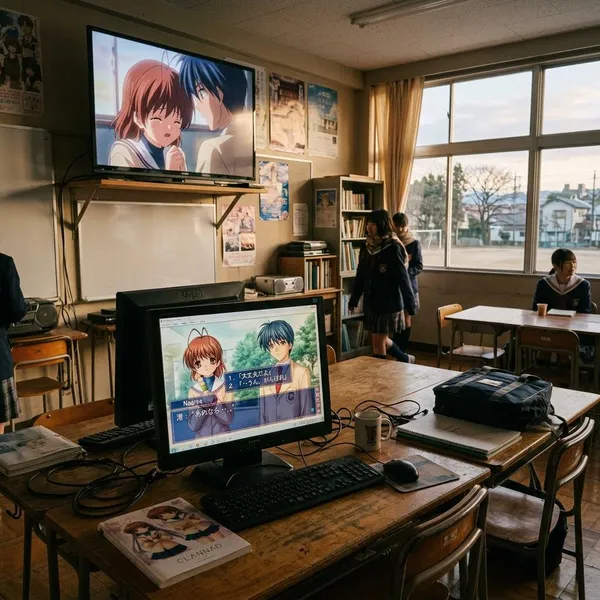
The main difference is not only "game versus show." It is structure. The visual novel is built around routes, so different choices lead Tomoya toward different character arcs. The anime has to turn that route-based story into one watchable timeline.
The visual novel has branching routes
The visual novel lets you follow separate routes for different characters, which is the biggest reason it feels more complete. Tomoya's choices matter to the path you see, and characters such as Kotomi, Tomoyo, Fuuko, and others get more space than an anime season can comfortably give them.
The anime combines multiple routes
The anime takes important material from different routes and fits it into one shared continuity. That makes it much easier to follow, especially if you have never played a visual novel before or do not want to think about route order, save files, or unlock conditions.
- What works better: the school setting feels like one connected community.
- What gets lost: some side stories become shorter and less layered.
- Who benefits most: viewers who want emotional momentum without route management.
The anime follows a smoother timeline
The anime's timeline is more direct because it does not need to reset into alternate paths. Tomoya and Nagisa remain the steady emotional center, so the story moves toward After Story with fewer interruptions.
Character and story depth
The visual novel is stronger when you care about the full cast and Tomoya's inner life. The anime is stronger when you want the emotional core to stay focused and easy to follow.
More inner thoughts in the visual novel
Tomoya feels more layered in the visual novel because you spend much more time inside his head. His sarcasm, bitterness, hesitation, and loneliness are not only shown through action; they are explained through narration and small reactions.
That extra access makes his growth feel slower and more believable. In the anime, you understand him through performance and direction. In the VN, you also see the thoughts he would never say out loud, which makes his emotional changes easier to trace.
More detail in side routes
Side routes are where the VN most clearly beats the anime for depth. A character who may feel like a supporting presence in the adaptation can become the center of a full emotional arc in the game.
Kotomi is a good example of a route that benefits from patience. Her story works better when there is time for quiet buildup, awkward distance, and gradual trust. If you tend to become attached to side characters and want their stories to feel complete rather than summarized, the VN is the safer choice.
More focus on Tomoya and Nagisa in the anime
The anime keeps Tomoya and Nagisa in front more consistently, and that helps the adaptation feel unified. Instead of asking the audience to invest equally in several possible paths, it builds the main relationship with a clear direction.
- Better for romance-first viewers: the central bond stays easy to follow.
- Better for emotional impact: music, voice acting, silence, and framing carry scenes quickly.
- Less ideal for completionists: some side-character nuance is reduced to protect pacing.
Pacing and time commitment
This is the practical deciding point for many people. The visual novel may be the richer version, but that only helps if you are willing to spend the time needed to finish it. The anime gives you the main emotional journey with far less friction.
If you are unsure, be honest about your habits. Someone who drops long games halfway through may get more value from finishing the anime than from starting the VN and never reaching its strongest material.
The visual novel is much longer
A full Clannad visual novel run is often a long commitment, commonly estimated around dozens of hours and often in the 80-hour range depending on reading speed and completion style. That time gives the story room to breathe, but it also makes the VN a poor fit if you only want a short emotional drama.
The anime moves through arcs faster
The anime cuts repetition and condenses route material, so it reaches major turns much faster. That makes it more approachable for casual viewers, anime-only fans, or anyone trying Clannad for the first time without committing to a long VN.
After Story is easier to reach in the anime
After Story is much easier to reach in the anime because it continues naturally after the first season. You do not have to understand the VN's route progression before getting to the part of Clannad many people consider its emotional peak.
For someone mainly curious about why Clannad has such a strong reputation, the anime is the faster path. For someone who wants After Story to sit on top of a broader foundation of character routes, the VN gives that payoff more surrounding context.
Clannad visual novel pros and cons
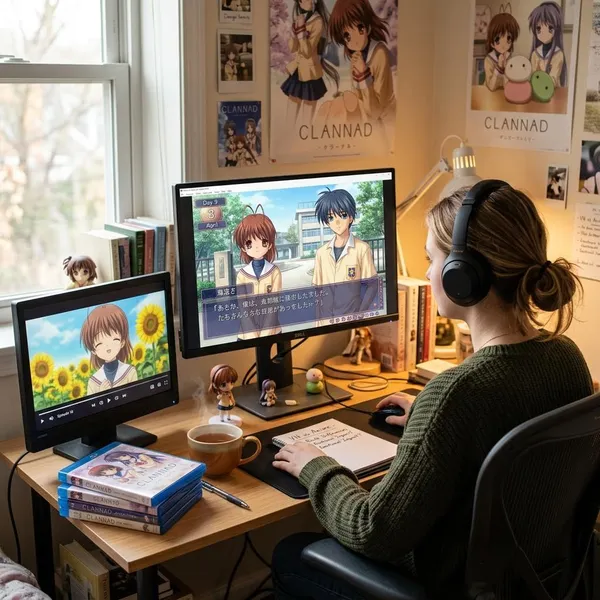
The visual novel is the better choice when completeness matters more than convenience. It gives you the widest view of Clannad, but it also asks for patience, repeated reading, and comfort with a slower format.
More routes and story detail
The VN's biggest advantage is the amount of story space. More routes means more time with the cast, more emotional setup, and a stronger sense that Clannad is about a whole community rather than only one relationship.
Deeper character development
Character development often feels deeper in the visual novel because changes happen across longer stretches of text. Tomoya benefits from inner narration, while side characters benefit from routes that do not have to compete as heavily for screen time.
This matters most if you like slow emotional turns: a character opening up after many small scenes, a joke that hides discomfort, or a quiet detail that only pays off much later. The anime can suggest those things, but the VN has more room to let them settle.
Slower pacing and longer playtime
The VN's weakness is also part of its identity: it is slow. Some common scenes may feel repetitive, some routes may matter to you more than others, and the full experience can feel heavy if you are reading in short, tired sessions.
- Good fit: you enjoy long character dramas and do not mind using a route guide.
- Bad fit: you want one clean story with little repetition.
- Best compromise: watch the anime first, then read the VN if specific characters leave you wanting more.
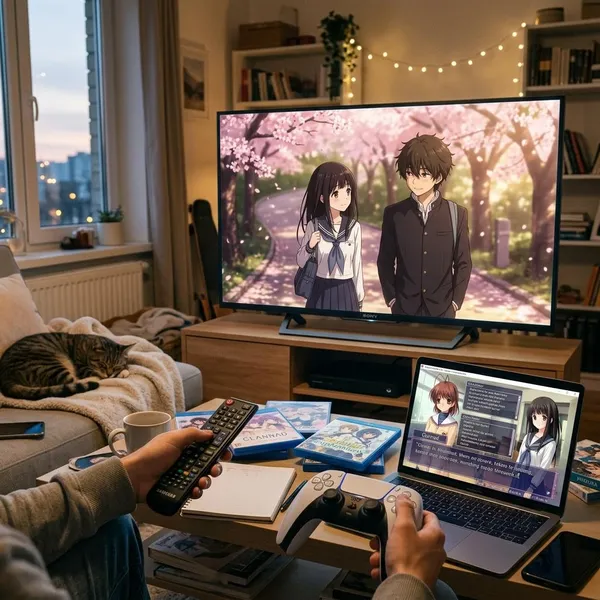
Clannad anime pros and cons
The anime is usually the better first recommendation because it is focused, emotional, and easier to complete. It does not replace the VN's full route structure, but it adapts the heart of Clannad in a form most people can actually finish.
Its biggest risk is expectation. If you go in expecting every heroine route to receive VN-level treatment, you will notice the cuts. If you go in wanting a strong central drama, the anime holds up very well.
Smoother story progression
The anime's smoother progression removes the biggest barrier of the VN: route friction. You can start episode one and follow Tomoya's life without planning choices or replaying shared material.
That makes it ideal for a first pass. It gives you enough context to understand the main emotional arc, and if you later move to the VN, you will have a clearer sense of which characters or routes you want to explore more deeply.
Strong audiovisual impact
The anime can hit harder in the moment because Kyoto Animation's direction adds music, voice acting, timing, color, and silence to scenes that are more internal in the VN. For many viewers, a line delivery or a quiet pause will be more immediately affecting than several paragraphs of narration.
This is especially true if you respond strongly to atmosphere. Clannad's warmth and sadness are not only in the plot; they are also in how a room feels, how a song returns, or how a character hesitates before speaking.
Less detail from side routes
The cost of the anime's focus is reduced side-route detail. Some characters still get memorable moments, but their arcs may feel compressed compared with the VN.
That does not make the anime a weak adaptation. It means it is choosing a different priority: keep the main emotional line strong, even if some side material becomes thinner. If your favorite character feels underused after watching, that is the clearest sign to try the visual novel next.
Conclusion
Choose the visual novel if you want the fullest version of Clannad and are ready for a long, route-based story; choose the anime if you want the most accessible and emotionally direct version first. For most newcomers, the anime is the easier starting point, while the VN is the better follow-up when you want more context, more side-character depth, and a slower look at Tomoya's world.
FAQS
Was Clannad originally a visual novel?
Yes. Clannad started as a visual novel by Key, and the anime was adapted from that route-based source.
Is the Clannad visual novel an eroge?
No. Clannad is known as an all-ages visual novel, so readers should not expect adult-content routes.
Is Clannad After Story separate from Clannad?
In the anime, After Story is a separate season title, but narratively it continues the same story. In the VN, it is part of the broader game progression rather than a separate work.
How long is the Clannad visual novel?
Many full runs land around 80 hours or more, though the exact time depends on reading speed, route order, and whether you use a guide.